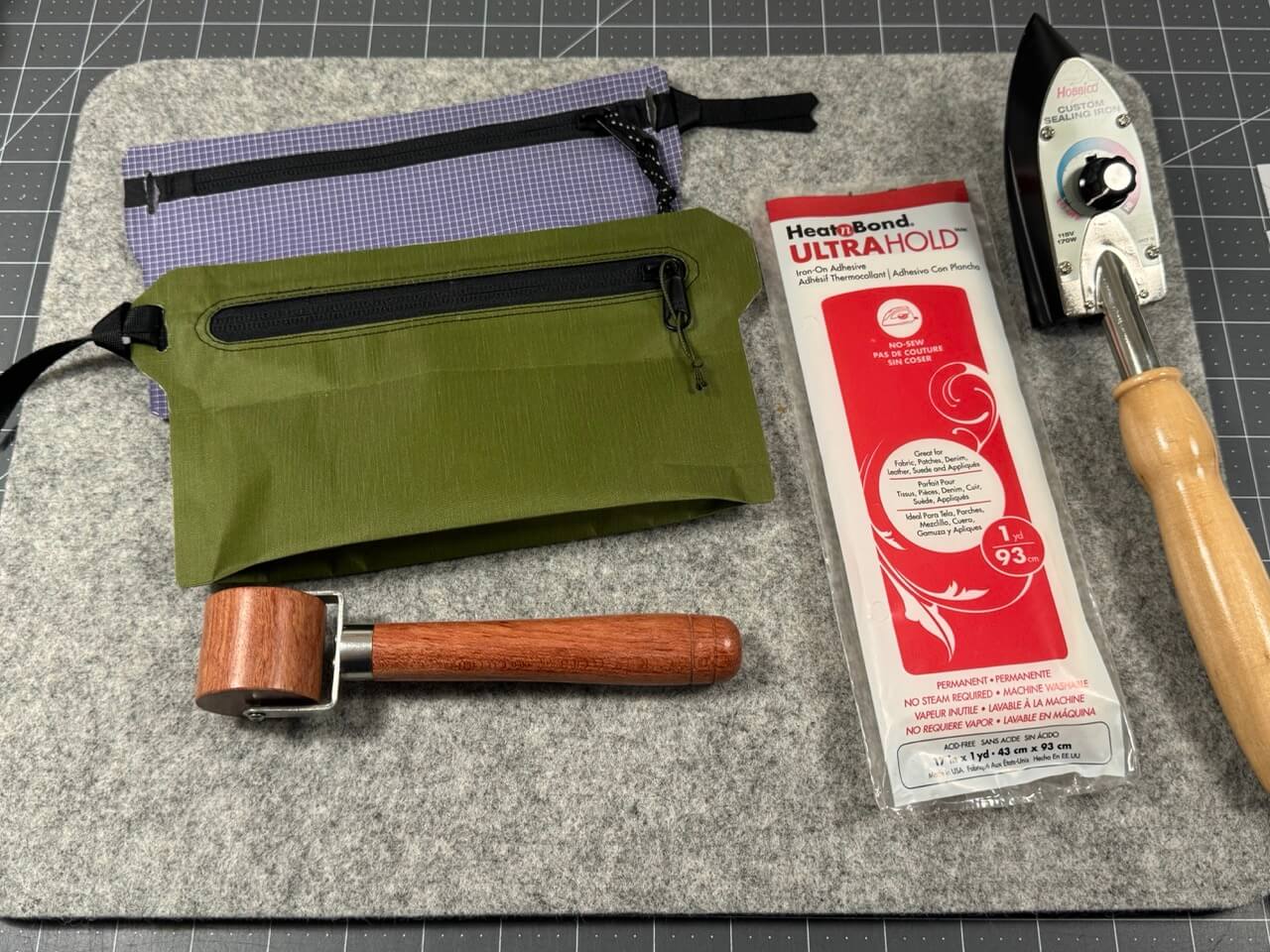
Tools for making bonded seams at home

Bonded Seams at Home

Lightweight, Waterproof MYOG without Sewing

If you’ve spent any time looking at modern outdoor gear, you’ve probably noticed the shift toward lighter, cleaner construction. No visible stitching. Crisp edges. Flat seams. This is the look of modern outdoor gear, and it’s a big part of why bonded and welded construction has become so popular.

While true industrial welding methods like RF or ultrasonic welding aren’t realistic for most home makers, the core idea is accessible. With heat‑activated adhesives, a basic iron, and some testing, you can experiment with bonded seams at home and apply the same design language to small DIY projects.

What "Thermal Welding" Means at Home

In commercial gear, welding refers to fusing thermoplastic materials together using heat and pressure instead of thread. At home, we can’t do that directly, but we can mimic the result by using a thin heat-activated adhesive film that melts under an iron and bonds two fabric layers together.

The seam isn’t truly welded, but it’s commonly called a bonded seam, and for small MYOG projects it gets surprisingly close in both function and appearance.

Bonded construction is widely used in performance apparel and outdoor gear to reduce bulk and eliminate stitching where it isn’t needed. One common industry reference is Bemis Sewfree, a family of heat-activated adhesive films designed for this exact purpose. The details aren’t important here. The takeaway is that this method is proven. We’re just adapting it for home tools and small projects.

For items like pouches and organizers, bonded seams can offer:

  • Clean, low-profile edges
  • No needle holes
  • Improved water resistance
  • A modern, technical look

The At-Home Approach

For DIY makers, HeatnBond Ultrahold is an accessible way to experiment with bonded seams. It’s a permanent, double-sided adhesive film that activates with heat from an iron.

This is where expectations matter.

There is no universal temperature, time, or pressure setting that works for every fabric. Different face fabrics, coatings, and weaves respond very differently to heat and adhesive flow. Some fabrics bond easily. Others barely bond at all.

Testing is not optional, and some fabrics will simply not work.

Before committing to a project, plan to:

  • Test multiple heat settings
  • Adjust dwell time under the iron
  • Apply firm pressure and let the seam cool before handling
  • Perform simple peel and flex tests

You may also find that some coated fabrics do not bond well or bond inconsistently. That’s just reality. Adhesives interact differently with coatings, laminates, and finishes, and not every fabric is a good candidate.

Uncomplicated Tools

You don’t need specialized equipment, but control and pressure make a big difference.

HeatnBond Ultrahold. Purchase in roll form (yardage) in black or white. The narrow tape is designed for no-sew hemming and lacks the paper backing.

Iron options

  • A household clothing iron (used dry, no steam)
  • A mini handheld heat press often for Heat Transfer Vinyl, for example Cricut EasyPress Mini
  • A hobby sealing iron with digital heat controls, for example Edge Banding Iron

Pressing Mat for Ironing. Protect your cutting mat from warping due to high heat

  • Conventional ironing board
  • Wool Ironing Mat
  • Cotton Towel folded over a few times

Pressure and sealing tools. Apply firm pressure on a benchtop surface while the adhesive cools improves bond strength.

This page contains affiliate links, meaning I make a commission for qualified purchases, at no cost to you. See Disclosures for more information.

Experiment with Fabrics

Midweight technical fabrics and many apparel-weight synthetics are good places to start. Both coated and uncoated fabrics can work, but results vary widely, and some coatings will prevent a durable bond altogether. I found Challenge EPX200, X-Pac VX21 and X-Pac V15 work very well as they have an uncoated poly taffeta backing. TPU heat sealable fabrics can be bonded without the need of additional adhesives. However, fabrics with heavy PU coatings or DWR do not work as well as uncoated fabrics.

The temp, dwell time, pressure, fabric face, and any coating all interact. Expect to experiment and expect some failures. That’s part of learning how bonded seams behave.

Thermal bonding can be a replacement for sewing with the right combination of factors. For smaller gear, it can reduce bulk, improve water resistance, and open up new design ideas. It may not be the best choice for load bearing seams.

Ready to try bonded seams for yourself? We’ll put these at-home concepts into practice by making a simple zipper pouch using bonded seams. It’s a low-risk project that’s ideal for dialing in heat settings, pressure, and technique before trying anything more complex.

Bonded Zipper Pouch